Vivi–Red Tithe Hostile Relationship
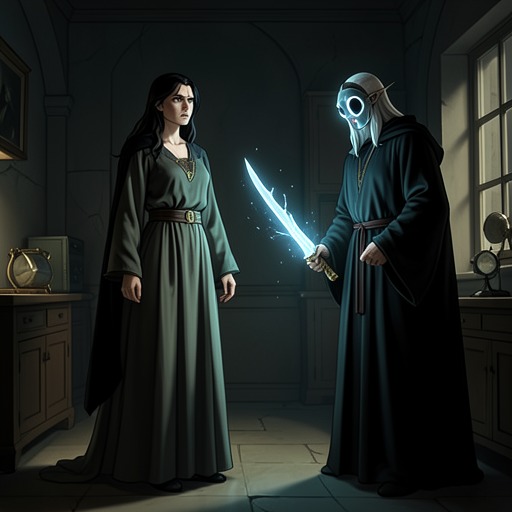
New Life as a Max Level ArchmageVivi–Red Tithe Hostile Relationship is a lethal opposition between Vivisari Vexaria and the Red Tithe, crystallized in the garden confrontation with the organization’s unidentified assassin known to Duke Caldimore as “Tobin.” The relationship is not a simple contest of strength: the Red Tithe relies on concealment, coercion, anti-magic equipment, and the exploitation of Saffra as a hostage, while Vivi answers with investigation, protection, and finally overwhelming spatial magic. Its decisive significance lies in the moment Vivi stops treating the encounter as an experiment and responds to the assassin’s threat against someone she cares about with absolute force.
The Red Tithe’s Threat and Method
The confrontation begins after Saffra and Vivi move through the foliage and find the supposed “Tobin” reclining beneath a gazebo instead of Isabella Caldimore. Saffra’s immediate reaction—flattened ears and a sudden halt—marks the man as dangerous before he openly identifies himself. His casual posture and mocking attention to Saffra make the danger deliberately intimate: he treats the garden as a pleasant setting while speaking as though murder were a social convenience. His nonchalance is itself a weapon, designed to make violence appear inevitable and to force the women to react on his terms.
The assassin refuses to recognize Vivi’s authority when she orders him to answer Saffra. He then makes the threat explicit, stating that he is willing to talk because neither woman will leave alive and that he intends to take Saffra after killing Vivi. He also invokes Duke Caldimore’s anger toward his daughter and suggests that Isabella and her father are involved in a punishment whose details may be deliberately cruel. This information changes the immediate stakes: Isabella is apparently alive and with her father, but Saffra is positioned as the next captive in a chain of political violence. The Red Tithe’s hostility therefore operates through both assassination and abduction, using family conflict as leverage.
The assassin’s equipment embodies the organization’s unusual danger. His dagger is a violet-and-black glass blade that Vivi recognizes as a monumental artifact, while his armor is described as nearly immune to skills and spells. He is also a high-Titled combatant with partial magical immunity, and the Red Tithe’s stat siphon has already limited Vivi’s available time and margin for error. The dagger is not merely a weapon in the scene; it is the object around which the assassin’s curiosity and suspicion gather, because Vivi’s reaction to it signals knowledge she has not yet explained.
The Duel and the Exposure of Identity
When the assassin throws the dagger, he does so with such force that even Vivi’s dramatically slowed perception cannot make the weapon move at a leisurely pace. Her first response is magical rather than physical: she reaches for Telekinesis, revealing how deeply her identity as a mage governs her instincts. The exchange consequently tests more than reflexes. It tests whether ordinary spellcraft can restrain an enemy whose weapon and armor were designed to resist exactly that kind of intervention.
The assassin’s threat does not make Vivi retreat. Instead, it makes her question him about the dagger, because understanding the artifact may be the key to understanding the Red Tithe’s purpose. He answers through provocation rather than disclosure, inviting her to examine the weapon while implying that her presence at a meeting with a duke, under an illusion, is itself suspicious. His language identifies Vivi as Nysari and draws attention to her disguise, forcing the concealed identity she has maintained in the encounter toward exposure.
The turning point arrives when the assassin recognizes her as Vivisari. His reaction is not fear alone but fascinated disbelief. He retrospectively interprets the entire fight as Vivi’s deliberate restraint, realizing that she had been allowing him to believe he was barely keeping up. His boast that he has killed dukes, bishops, and even a prince contrasts with his astonishment at facing the savior of the world. The encounter thus reverses his preferred hierarchy: the professional killer who has treated powerful people as trophies becomes the observer of a power he cannot categorize.
The violet-and-black dagger intensifies that reversal. The assassin admits that an artifact of such magnitude would explain why Vivisari had appeared after a century of silence, then prepares to abandon his earlier playfulness. His disappearance initially seems like an attempt to attack from behind, but he reappears beside Saffra instead. The maneuver reveals the core logic of the Red Tithe’s hostility: when direct opposition becomes uncertain, the organization targets Vivi through the person she is protecting.
Vivi’s Retaliation and the Spatial Rift
The threat to Saffra changes Vivi’s conduct. Until that instant, she has been studying the assassin and managing the battle with calculated restraint, even while dealing with his armor, dagger, mobility, magical resistance, and the Red Tithe’s stat siphon. Once he appears beside her apprentice, calculation gives way to an instinctive response on behalf of someone she cares about. Vivi finally takes the fight seriously, and the text frames that decision as both emotional protection and “absolute prejudice” against an unstable killer.
Vivi answers with [Carve the Firmament], borrowing magic from the grimoire of a cautionary tale. The spell does not merely strike the assassin or attempt to penetrate his armor. It attacks the fundamental fabric surrounding the Red Tithe, cutting into reality itself. She tears away a bleeding handful of voidstuff and throws it into the ether, sealing what she can before the damage spreads far enough to collapse Meridian. The scale of the response clarifies the asymmetry between the combatants: the assassin’s methods are specialized and lethal, but Vivi possesses magic capable of threatening the city in the act of defeating one man.
The Red Tithe’s alien armor proves unable to withstand every form of magic. The assassin disappears, leaving behind a jagged, gaping wound in reality described as a black-but-not-black spatial rift. The rift is both the mark of Vivi’s victory and the physical remainder of an action she cannot fully control. It makes the hostility material: the conflict has opened a breach in the world, not merely ended a duel.
Vivi immediately prioritizes Saffra. She Blinks to her apprentice, grabs her, and Blinks them far away, then teleports back alone to the garden. This sequence separates rescue from reckoning. Saffra is removed from the assassin’s reach before Vivi assesses the consequences of her spell, while Vivi returns to confront the result directly. The action shows that protection is not an abstract principle in their relationship; it determines the order of Vivi’s decisions under extreme pressure.
Consequences and Meaning of the Hostility
The aftermath is deliberately unstable. Vivi discovers that the spatial wound is stable and that she has not accidentally erased an entire city, a possibility made credible by the magnitude of [Carve the Firmament]. Yet the survival of Meridian does not make the ending clean. Vivi is fairly sure she has killed the assassin, but the uncertainty preserves the Red Tithe as an unfinished threat rather than a neatly resolved enemy. His disappearance into the rift can be read as defeat, death, or escape through a phenomenon Vivi herself created.
The encounter also exposes a contradiction at the center of the relationship. The assassin treats Vivi as an extraordinary prize once he learns her identity, addressing her through the reputation of a world-savior even as he continues to threaten her and Saffra. Vivi, meanwhile, begins by seeking knowledge about his dagger and learning from his attacks, but abandons that controlled posture when Saffra becomes vulnerable. Curiosity and protection coexist until the latter overrides the former. The Red Tithe’s hostility therefore forces Vivi to reveal not only her face, but the boundary at which observation ends and decisive violence begins.
The garden confrontation establishes the Red Tithe as an enemy capable of bringing high-level assassination, magical resistance, political coercion, and dimensional danger into the same scene. It also establishes Vivi as an opponent the organization cannot safely measure by ordinary combat expectations. Its assassin can threaten her shields, move through the battlefield, and exploit the Red Tithe’s stat siphon, but he cannot assume that anti-magic defenses will protect him from magic that cuts reality itself. The hostile relationship is consequently defined by escalation: the Red Tithe turns personal attachments into weapons, and Vivi answers by making the battlefield itself answerable to her will.